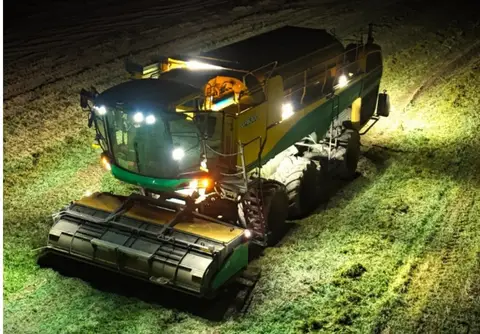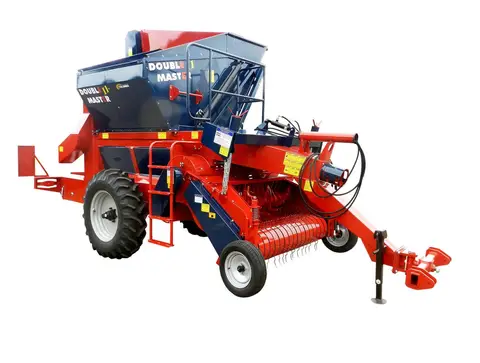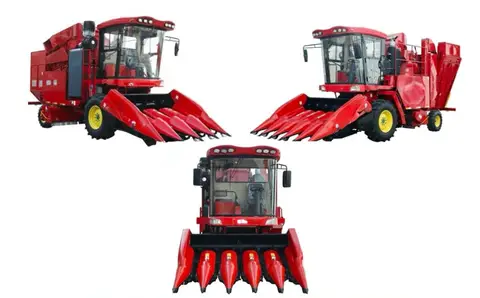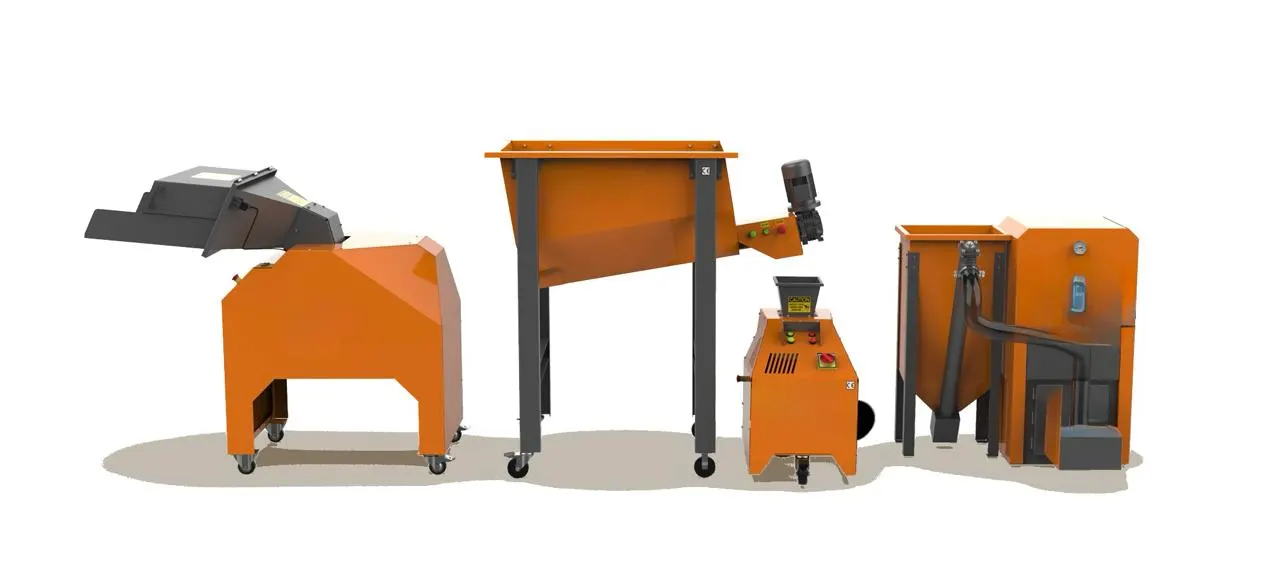
Straw after harvest is a raw material a farm has every year. In bales it takes up a lot of space and is cheap to transport only over short distances. Pelleting compacts it several times over and turns it into fuel or bedding that is easy to store, transport and dose.
Production stages
1. Bale breaking. Square or round bales are opened and chopped to pieces a few centimetres long.
2. Drying — if needed. For pelleting the raw material has to be dry: the guide is roughly 10–15% moisture. Straw baled in dry weather and kept under cover often meets this already, and no dryer is needed. This makes the line noticeably cheaper than a sawdust line.
3. Fine grinding. A hammer mill reduces the straw to a fine fraction. The more even the grinding, the stronger the pellet.
4. Pelleting. A pellet press forces the material through a die. Under pressure and heat the particles bind together, giving a dense pellet. For straw, moistening or adding steam before the press is often provided so that the pellet holds together better.
5. Cooling and sieving. The pellet leaves the press hot and brittle. It hardens in the cooler, and the dust is screened off and returned to the process.
6. Packing. Into bags, big bags or in bulk into a bin.
How straw differs from wood
- Higher ash content. More ash is left after burning than from wood pellets.
- The ash melts at a lower temperature. In boilers not designed for agro-pellets, slag can form. So the buyer’s boiler, or your own, should be checked in advance.
- The raw material is abrasive. Straw contains silica, which speeds up wear of the die and rollers. Wear parts should be included in the production cost.
- Low bulk density. Feeding straw into the line needs larger conveyors and bins than sawdust does.
These are not drawbacks of the technology but its particular features: they are simply taken into account when selecting the equipment and the sales market.
Stationary line, mobile unit or briquettes
A stationary line is for a stable large volume of raw material and sales. It gives the lowest cost per tonne but needs buildings, electrical power and logistics to bring the bales to the line.
A mobile unit comes to the raw material: it works next to the bale store or right on the farm. It is convenient when the straw is spread over several sites.
Briquetting is simpler and cheaper to start with: a briquette press is less demanding about grinding. Briquettes suit solid-fuel boilers with manual loading; pellets suit automatic feeding.
Where to start the calculation
- How much straw you have per year and at what moisture.
- Where the product will go: your own boiler house, sale as fuel, or animal bedding.
- How much electrical power is available on site.
- How many shifts and months per year the line will run.
From these figures the press capacity and the configuration are selected — with or without a dryer, with automatic or manual packing.