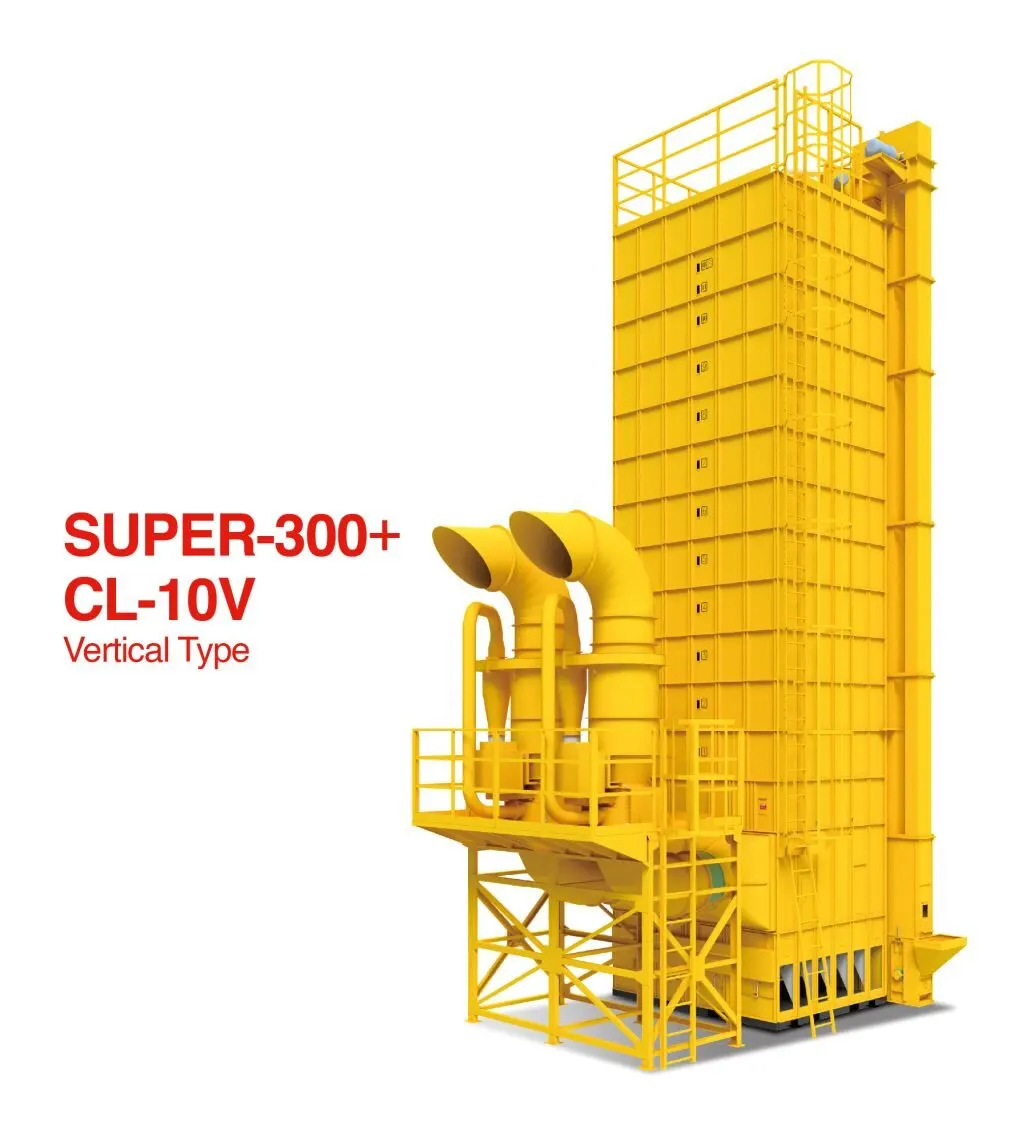
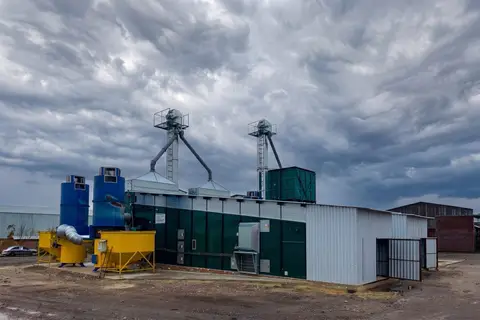
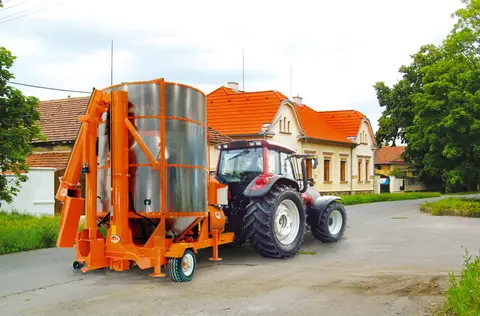
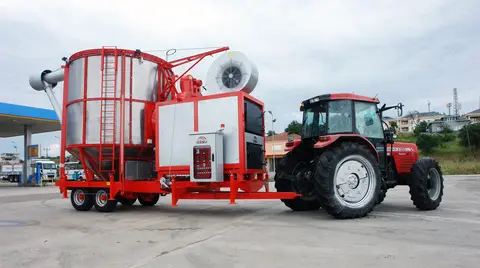
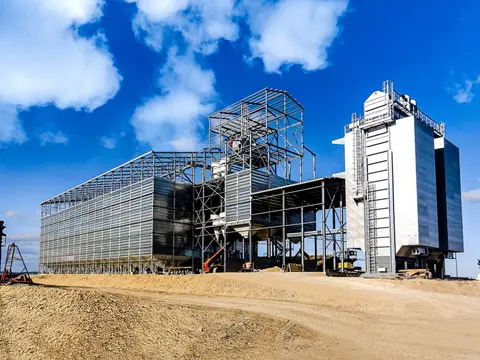
Taiwanese Suncue dryers are designed for paddy: they dry slowly, at a low temperature and with tempering, so that the kernel does not crack and more whole rice comes out of milling. The same dryers handle wheat, maize, soya, pulses and seed.
How the dryer dries rice
Suncue dryers are recirculating batch dryers. The grain travels in a loop: it descends through the drying zone, where warm air passes through it, an elevator lifts it to the top, and there the rice tempers. In that time moisture moves from inside the kernel to the surface, and on the next pass the grain gives it up without overheating. When the moisture meter shows the set value, the dryer stops by itself.
Rice is dried at 0.5–1.5% of moisture an hour: fast hot drying causes cracks, and the rice breaks in milling. Parts worn by abrasive rice are made of stainless steel. The dryer is protected by a thermal relay, an air pressure switch, flame sensors, a timer and a full-load alarm.
Series
- SUPER: general-purpose dryers for 2.5–60 t, from the farm-scale SUPER-60 to the SUPER-600B with a husk furnace.
- PHS: large dryers for 3.6–138 t for rice mills; the PHS-660B and PHS-1380B are loaded by an elevator at up to 120 t/h.
- MD-165: two modes, low-temperature for rice and wheat and high-temperature for maize (1.8–2.6% an hour).
- CPR-165 and CPR-390: for seed, rapeseed and pulses; seed rice and wheat at 0.2–1.0% an hour, rapeseed at 0.1–0.5%.
Models
| Model | Paddy, t | Wheat, t | Maize, t | Heat source |
|---|
| SUPER-60 | 2.5–6 | 3–7.3 | 3.1–7.4 | diesel, gas, biomass |
| SUPER-120 | 2.8–12 | 3.4–14.6 | 3.5–14.8 | diesel, gas, biomass, steam, dual-fuel |
| SUPER-300 | 4–30 | 5–36.4 | 5–36.9 | diesel, gas, biomass, steam, diesel + husk |
| SUPER-600B | 10–60 | 12.1–60 | 12.1–60 | SB-130 husk furnace |
| PHS-130 | 3.6–13 | 4.4–15.8 | 4.4–16 | diesel, gas, biomass, dual-fuel |
| PHS-320 | 7.8–32 | 9.6–38.8 | 9.6–39.4 | diesel, gas, biomass, steam, dual-fuel |
| PHS-660B | 16–66 | 19.5–80.1 | 19.7–81.3 | SB-130, SB-200 husk furnaces |
| PHS-1380B | 30–138 | 37–138 | 37.5–138 | SB-130, SB-200 husk furnaces |
| MD-165 | 5.7–13.2 | 6.9–16.2 | 7–16.5 | diesel, gas, biomass, steam, dual-fuel |
| CPR-165 | 6.5–13.3 | 7.5–16.3 | 7.5–16.4 | diesel, gas, husk, biomass, steam |
| CPR-390 | 14.8–32.1 | 18–39 | 18.3–39.6 | diesel, gas, husk, dual-fuel |
Heat sources
- Diesel or kerosene: a burner on the dryer.
- LPG or natural gas: a gas burner.
- Steam from a boiler: for the SUPER-120, SUPER-300, PHS-320, MD-165 and CPR-165.
- Rice husk or other biomass: the “B” versions with a Suncue SB or BB-18 heat generator.
- Two fuels: diesel and husk or gas and husk, to order.
For a rice mill the most economical fuel is its own husk: the husk from one tonne of paddy is enough to dry about three tonnes. Power supply is three-phase 220, 380, 415 or 440 V; the smallest SUPER-60 is also made in a single-phase version.
What we need to select a dryer
- what you dry: commercial or seed rice, wheat, maize, rapeseed, pulses;
- the seasonal volume and how many tonnes a day come from the field;
- the initial and required moisture;
- the fuel you have: husk, gas, diesel or steam;
- what the site already has: an intake pit, elevators, bins, a store.