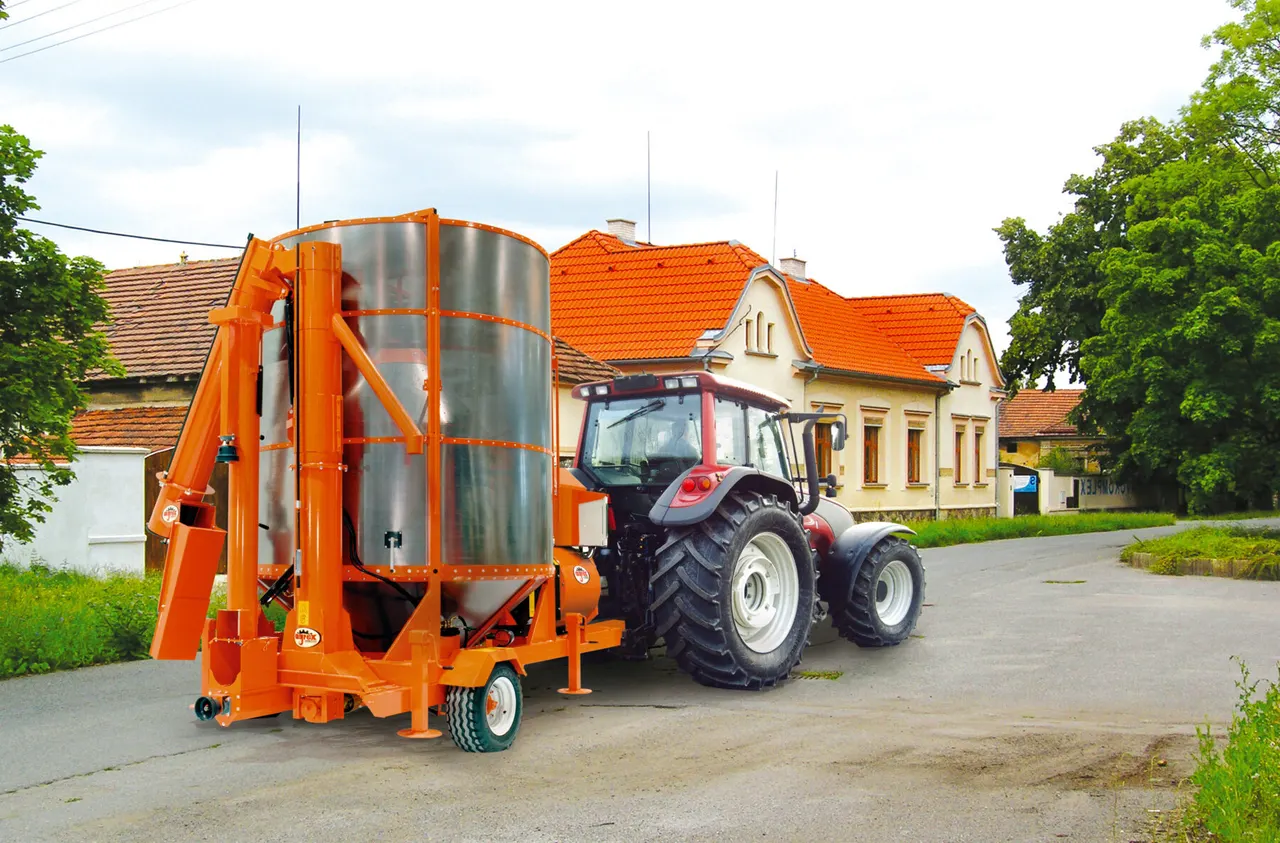
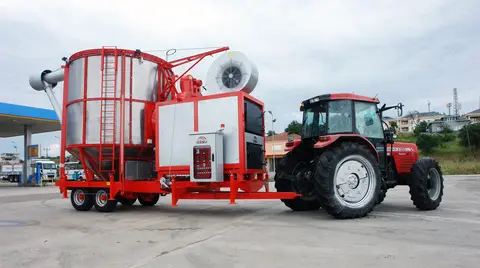
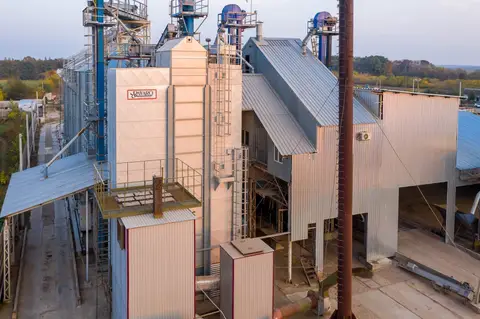
Agrex AGD are Italian mobile batch grain dryers. One machine does the whole cycle: loading, drying, cooling and unloading. It needs no foundations, buffer silos or complex design work, only a level site, so drying can start very quickly.
They dry maize, wheat, barley, rice, soya, rapeseed and sunflower.
How Agrex differs from other mobile dryers
- External auger or elevator. Grain recirculation is outside the hopper: the unit is easy to service and does not take up the centre of the hopper. An auger is simpler and cheaper; an elevator is gentler on the grain.
- Two-mode heat exchanger. With the heat exchanger the grain is dried by clean hot air free of combustion products; in direct mode the output is higher.
- The heat exchanger can be fitted later, after the dryer has been bought.
- Tractor PTO drive is part of the basic specification, so the dryer works where there is no electricity.
- An on-board generator powers the automation when running from the PTO.
- Multi-fuel burner: changing fuel does not mean changing the dryer.
- A double aspirator removes dust from the top and the bottom.
- A flap regulates the recirculation flow: fewer passes through the auger, less damage to the grain.
- The main fan is centrifugal, so it copes well with a heat exchanger and a solid-fuel heat generator.
The cycle
- Loading. The hopper is filled with grain; the burner and fan are off.
- Drying. The fan and burner start, the grain recirculates and hot air is blown through it. The operator or the automation stops the process when the required moisture is reached.
- Cooling. The burner switches off and the fan blows cold air through the grain.
- Unloading. The conveying mechanisms are switched to discharge.
Model range
| Model | Hopper, m³ | Tractor, hp | Air, m³/h | Burner, kcal/h | Maize 30 → 14%, t/day | Wheat 20 → 14%, t/day | Soya 20 → 14%, t/day | Sunflower 14 → 7%, t/day |
|---|
| AGD10 | 10 | 50 | 25,000 | 600,000 | 35–61 | 48–80 | 42–70 | 27–46 |
| AGD15 | 15 | 60 | 25,000 | 600,000 | 50–85 | 49–120 | 60–100 | 39–64 |
| AGD18 | 18 | 70 | 25,000 | 600,000 | 65–110 | 72–145 | 76–130 | 49–79 |
| AGD20 | 20 | 80 | 45,000 | 900,000 | 72–115 | 96–170 | 88–137 | 55–92 |
| AGD25 | 25 | 80 | 45,000 | 900,000 | 86–120 | 120–200 | 105–145 | 68–110 |
| AGD31 | 31 | 90 | 45,000 | 900,000 | 110–190 | 150–250 | 130–220 | 85–135 |
| AGD33 F | 33 | — | 53,000 | 900,000 | 115–200 | 160–280 | 140–250 | 95–156 |
| AGD40 | 40 | 120 | 73,000 | 1,634,000 | 130–172 | 186–202 | 170–202 | 102–132 |
| AGD45 | 45 | 120 | 73,000 | 1,634,000 | 158–195 | 213–242 | 190–222 | 122–152 |
| AGD55 | 55 | 130 | 73,000 | 1,634,000 | 190–220 | 261–292 | 231–262 | 149–180 |
| AGD55 F | 55 | — | 73,000 | 1,634,000 | 190–220 | 261–292 | 231–262 | 149–180 |
Models marked F are stationary, with electric drive and a bucket elevator. The others run from the PTO or on electricity. Outputs are indicative: they depend on the crop, the moisture, the air temperature and the regime. For small batches of nuts and seed there is the compact 3 m³ AGD3.
Fuel
- Natural gas or LPG: the most convenient option where a gas supply exists.
- Diesel or heating oil: a self-contained solution for sites without gas.
- Solid fuel: pellets, wood chips, firewood, straw, through a heat generator.
- Steam, hot water or thermal oil: where a boiler house already exists, for example at an oil mill.
Agrex or a tower dryer
| Criterion | Agrex | Continuous tower dryer |
|---|
| Start-up | quick | longer, depends on construction |
| Foundations | not needed | usually needed |
| Buffer silos | not needed | often needed |
| Mode | batch | continuous |
| Mobility | yes | no |
| Capital cost | lower at the start | higher |
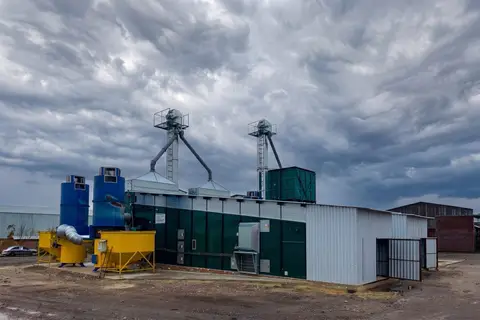
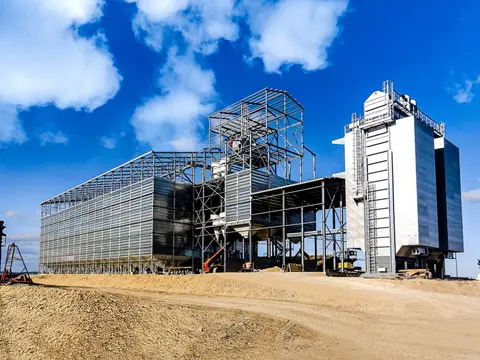
| Who it suits | farmers, medium-sized farms, back-up or mobile drying | elevators, large farms, large seasonal volumes |
Tell us the crops, the seasonal volume, the grain moisture and the fuel available, and we will select a model and specification.