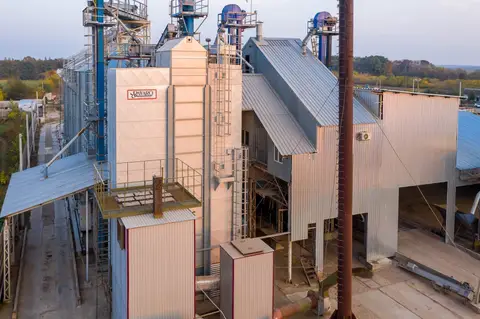
A batch grain dryer dries grain in batches: loading, drying, cooling, unloading. Dryers from the Italian manufacturer Ravaro, in business since 1967, are designed for exactly this mode and can later be converted to continuous operation.
Who a batch dryer suits
- Family farms and small farm businesses that need to dry up to 200 t of grain a day.
- Growers of rice and other crops that need tempering.
- Businesses that dry small lots of different crops and varieties.
- Seed producers, for whom there is a special version.
Continuous operation needs an unbroken supply of grain, buffer bins and round-the-clock organisation. A batch dryer needs none of that.
How it works
- Loading. The elevator fills the column until the level sensors trip.
- Drying. The fans and the heat source start. From time to time the dryer discharges a portion of grain at the bottom and the elevator lifts it to the top, so that the grain is mixed and dries evenly.
- Cooling. Once the required moisture is reached, the burners switch off and cold air is blown through the grain.
- Unloading. The fans stop and the elevator discharges the batch.
Features
- Any fuel: gas, diesel, solid-fuel heat generators, heat exchangers.
- Full insulation: all hot and warm zones of the column are clad in sandwich panels with non-combustible mineral wool. This is estimated to save 10–20% of fuel or more, depending on the weather and the crop.
- Heat recirculation: a differential system returns part of the exhaust air; the drier the air, the more of it is returned.
- No elevator pits: Ravaro elevators join the dryer without pits, towers or spouting.
- Riello burners are fitted directly in the air duct, so no heat is lost in transfer. Gas, diesel and dual-fuel burners are available; diesel ones come with a stainless steel combustion chamber and spark arrester.
Materials
Paddy is highly abrasive, and Ravaro comes from Italy’s main rice-growing region, so the dryers are designed to keep the grain from rubbing against the structure. The body is made of Aluzinc and the ducts of Corten steel.
Model range
| Model | Column capacity, m³ | Electrical power, kW | Thermal power, kW, max. |
|---|
| R14 | 13.6 | 9.9 | 326 |
| R17 | 16.9 | 13.4 | 581 |
| R21 | 20.3 | 14.9 | 698 |
| R26 | 25.6 | 17.7 | 814 |
| R30 | 29.8 | 21.7 | 1,012 |
| R36 | 35.7 | 21.7 | 1,012 |
| R40 | 39.9 | 25.2 | 1,163 |
| R45 | 44.1 | 28.7 | 1,163 |
| R55 | 54.1 | 31.2 | 1,395 |
| R61 | 60.3 | 39.2 | 1,802 |
| R67 | 66.6 | 46.2 | 2,326 |
| R73 | 72.9 | 46.2 | 2,326 |
| R89 | 88.3 | 63.5 | 3,488 |
| R97 | 96.7 | 75.5 | 4,186 |
This is only part of the range. The column is made from 2 to 10 m wide: wide and low for installation under a canopy, tall and narrow for a tight site.
Combined continuous and batch dryers
Such a dryer runs continuously when a high daily output is needed and switches to batch mode when there is little grain or it arrives in small lots: the cooling zone becomes a tempering zone. It is also a way to start with a simple batch dryer and later expand the plant to continuous operation.