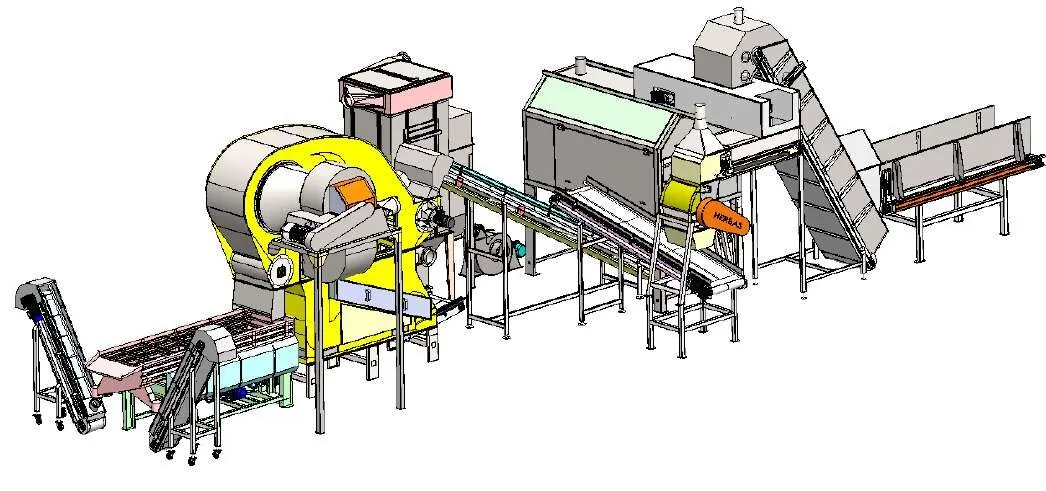
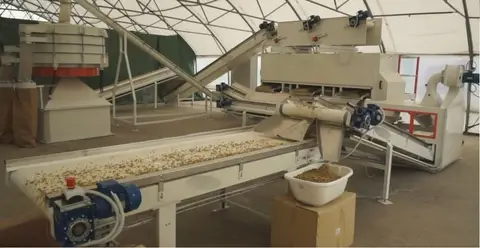
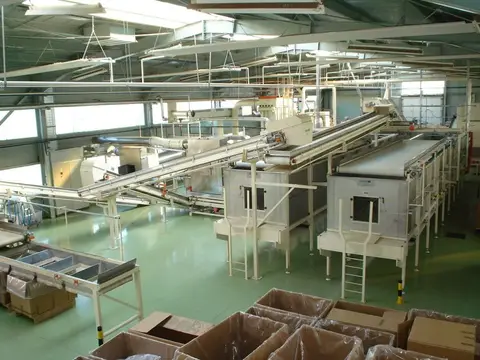
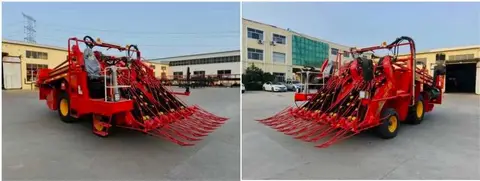
Herbas (Croatia) builds complete lines for dried medicinal and aromatic herbs and for rose hips. A line strips the leaf from the stem, cuts the material to the required fraction, removes stones, metal and dust, and bags the product straight away.
We select a line for your raw material and volume, supply the equipment and support commissioning. Below are eight standard configurations with the manufacturer’s rated figures.
Standard lines
Line
Raw material
Capacity
Power
Threshing, rubbing and separation
mint, sage, lemon balm, nettle, stevia
up to 1,000 kg/h
up to 30 kW
Rubbing with batch feeding
dried herbs
200–300 kg/h
up to 15 kW
Rubbing of baled and loose material
herbs in bales or loose
up to 600 kg/h
up to 18 kW
TBC (tea bag cut)
herbs in bales or loose
400–500 kg/h
up to 35 kW
Fine cutting of baled and loose material
straw and stems
up to 400 kg/h
up to 80 kW
Fine-cut pellets
powder or milled material
400–500 kg/h
up to 35 kW
Rose hip separation
whole dried fruit
up to 400 kg/h
up to 10 kW
TBC for rose hips
whole dried fruit
up to 900 kg/h
up to 18 kW
The raw material must reach the line already dried to the required moisture content.
Threshing, rubbing and separation: up to 1,000 kg/h
The most versatile line: it handles mint, sage, lemon balm, nettle and stevia. One or two operators run it, and the product suits both extraction and loose tea.
Feeding. A buffer with a feeder delivers the material in an even flow. The buffer is filled by a loader or a conveyor.
Threshing or rubbing. Both separate the leaf from the stem. Threshing gives a coarser fraction, while rubbing also reduces the leaf to a set size. The mode is changed by redirecting the flow, and the idle side of the line can be reset for another crop in the meantime.
Cleaning. The CFS-800 air separator and a vibrating sieve remove impurities. Sieves are made to order and are quick to change.
Bagging. The finished product goes straight into sacks.
Manufacturer’s video: rubbing and separation line
Rubbing with batch feeding: 200–300 kg/h
A compact line for small batches. The material is cut into pieces of up to 100 mm and fed to the rubbing machine, where the leaf is stripped from the stem mechanically. Coarse stem leaves at the back of the machine and falls into a container by gravity.
Fine stem and leaf pass onto a vibrating conveyor that spreads the layer ahead of the air separator. The air stream divides the material by weight: stones, metal and stem fall into a container, and the fan carries the light fraction to a two-deck vibrating sieve that splits it into three fractions. The cut point is set by the air speed at the control cabinet.
Rubbing of baled and loose material: up to 600 kg/h
A slicer cuts square bales into layers 20–50 mm thick, and a feeder delivers them evenly to the RB-400 cutter.
The rubbing machine separates the leaf blade from the stem and reduces it, usually to 5 mm. There are two versions: the compact REB-100 and the higher-capacity REB-200.
A VS series vibrating sieve divides the product into up to four fractions. Y-shaped augers at the sieve outlets let sacks be changed without stopping.
A pulse-jet bag filter collects dust from several points along the line.
TBC line: 400–500 kg/h
TBC (tea bag cut) is a fine cut of herbs for tea bags. Baled or loose material is cut to 20–50 mm, the air separator removes stem, stones and metal, and a two-deck planetary sieve splits the light fraction into three parts. The last auger bags the product and a bag filter collects the dust. Orange peel is processed by the same method.
Manufacturer’s video: TBC line for herbal tea bags
Fine cutting of baled and loose material: up to 400 kg/h
This line reduces straw and stems. A loader places bales on a lifting and tipping platform; a wide chain conveyor with high sides acts as a buffer, holding the next bale while the previous one is processed. The conveyor length is made to order.
Size reduction is in two stages: a bale-breaking mill opens the bale, pneumatic conveying carries the material to a second mill that brings it to the required size. A vibrating sieve returns the coarse fraction for regrinding. The line is run from a touch panel and needs two people, one feeding and one packing.
Fine-cut pellets: 400–500 kg/h
The line does two things: it raises the density of the product so that it is easier to fill into tea bags, and it puts dust to use. An auger feeds powder or milled material to a pellet press, the pellets are cooled with air at once, and a roller mill with an adjustable gap grinds them to the required fraction. The mill runs in a closed loop with an RS series planetary sieve (up to five decks): coarse material returns for regrinding, the good fraction is bagged, and the dust goes back into production.
Lines for rose hips
Rose hip separation, up to 400 kg/h. A crusher-separator opens the dried fruit and divides it into flesh, seeds and hairs. In the HPS 630 air separator the air stream lifts the hairs and drops them into a closed container, while dust goes to the filter. The heavy fraction reaches a vibrating sieve: seeds pass through the mesh and flesh runs off into a container. Magnets can be fitted at the outlets. The line also suits some other dried fruit from which seeds have to be removed.
TBC for rose hips, up to 900 kg/h. The line starts the same way, but the flesh from the vibrating sieve goes to an HM series mill working in a closed loop with an RS planetary sieve. The good fractions are bagged directly.
What to tell us for a quotation
the crop and the form of the material: loose or baled, moisture content;
the capacity you need, kg/h;
the end product: loose tea, tea bags, material for extraction;
the size of the building and the electrical power available.
Herbas (Croatia) lines process dried chamomile: they separate the flower heads from the stem, grade them into class 1 and class 2, clean them of impurities and turn the stem into pulvis, a fine fraction for tea and…
Herbas (Croatia) designs and builds equipment for handling tobacco after harvest and curing: PMD processing lines, leaf inspection lines, lines for receiving tobacco in C-48 cases and for processing stems, and…