Herbas lines for dried chamomile: flower heads separated and graded into class 1 and 2, stem milled into pulvis. Basic line up to 85 kg/h, full line up to 300 kg/h.
Herbas (Croatia) lines process dried chamomile: they separate the flower heads from the stem, grade them into class 1 and class 2, clean them of impurities and turn the stem into pulvis, a fine fraction for tea and extraction.
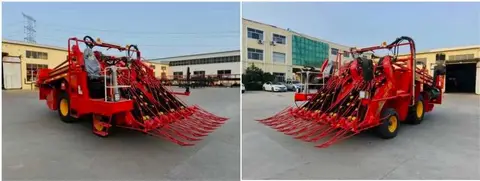
The manufacturer offers two standard configurations: a basic line with manual loading and a fully automated one. The crop is picked with a chamomile harvester and dried before processing.
The two configurations compared
Parameter
Basic line
Automated line
Capacity
up to 85 kg/h
up to 300 kg/h
Electrical power
3 kW
up to 40 kW
Loading
by hand into the hopper of the head separator
into a buffer with a feeder, from crates or loose
Flower head classes
class 1 and 2
class 1 and 2; optical sorting and manual inspection for class 1
Stem
cut to 10–20 mm
cut and milled into pulvis
Basic line: up to 85 kg/h
A solution for small volumes: all the equipment together draws only 3 kW.
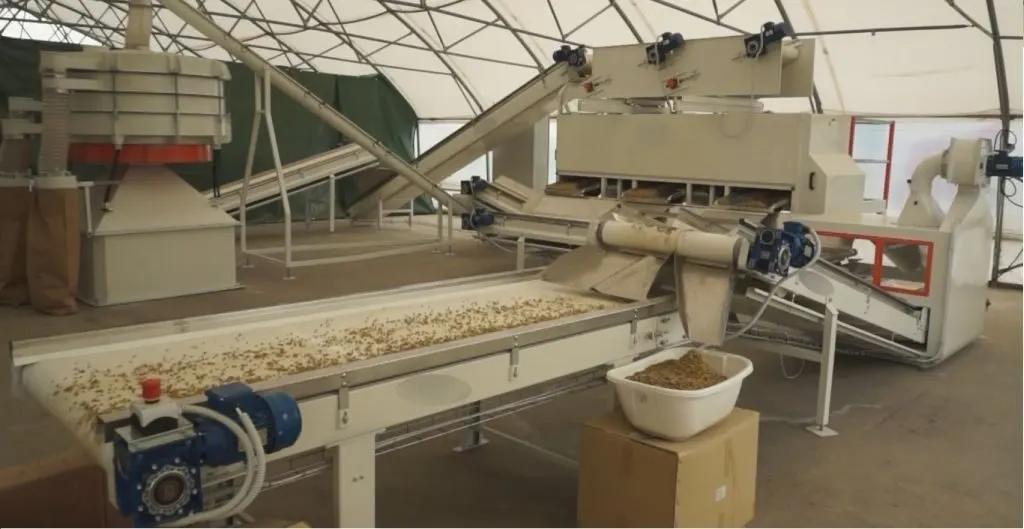
Chamomile is loaded by hand into the hopper of the head separator. The heads come off the stem, and the stem is cut into 10–20 mm pieces (16 mm is preferred).
The heads pass a string sieve and an air separator that grades them into two classes and removes stones, metal and dust by weight.
A belt conveyor delivers the product to containers and also serves for visual inspection.
What is left after the head separator goes to a vibrating sieve that divides it into dust, extra pulvis and a mixture of stem and petals.
Manufacturer’s video: small chamomile processing line
Automated line: up to 300 kg/h
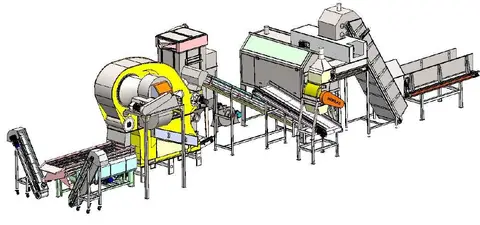
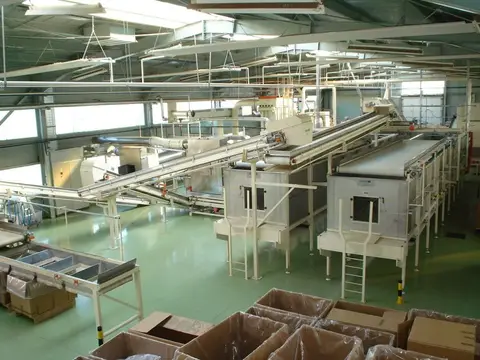
The full line includes a dosing system, conveyors, cylindrical and air separators, cutters, a mill, head separators, planetary sieves and a filter.
Feeding. Chamomile is tipped into the buffer and the feeder delivers an even flow. A PLC controls the feed from sensor signals, and the mode is programmed to suit the condition of the material.
First separation. A cylindrical separator divides the material into a fraction rich in heads and a mainly stem fraction. The stem fraction is coarsely cut on the RB-400 cutter and passed through a second separator to recover the remaining heads.
Milling. The stem is milled on the HM 600 mill into industrial pulvis. The mill works in a closed loop with an RS planetary sieve: coarse material returns for regrinding.
Heavy impurities. An air separator removes metal, stones and soil ahead of the head separator; according to the manufacturer, this reduces stoppages.
Flower heads. The RGK series separator trims the head to 16 mm, and the remaining stems are cut on the RB-200 cutter to 0–10 mm. A second air separator grades the heads; class 1 can also be passed through an optical sorter.
Residue. Augers carry the mixture of stems, petals and dust to an RS planetary sieve, where extra pulvis is separated out.
Dust. A pulse-jet bag filter collects dust from several points along the line and cleans itself with compressed air.
Manufacturer’s video: full chamomile processing line
Products from the full line
flower heads of class 1 and class 2;
extra pulvis, for example 0.25–1 mm;
industrial pulvis, for example 0.25–1 mm;
dust, finer than 0.25 mm.
Layout
In the manufacturer’s drawing the full line has 27 items and occupies 11,595 × 11,580 mm. There is a simpler 13-item layout without the cylindrical separator and the mill. It consists of:
Herbas (Croatia) builds complete lines for dried medicinal and aromatic herbs and for rose hips. A line strips the leaf from the stem, cuts the material to the required fraction, removes stones, metal and dust, and bags…
Herbas (Croatia) designs and builds equipment for handling tobacco after harvest and curing: PMD processing lines, leaf inspection lines, lines for receiving tobacco in C-48 cases and for processing stems, and…