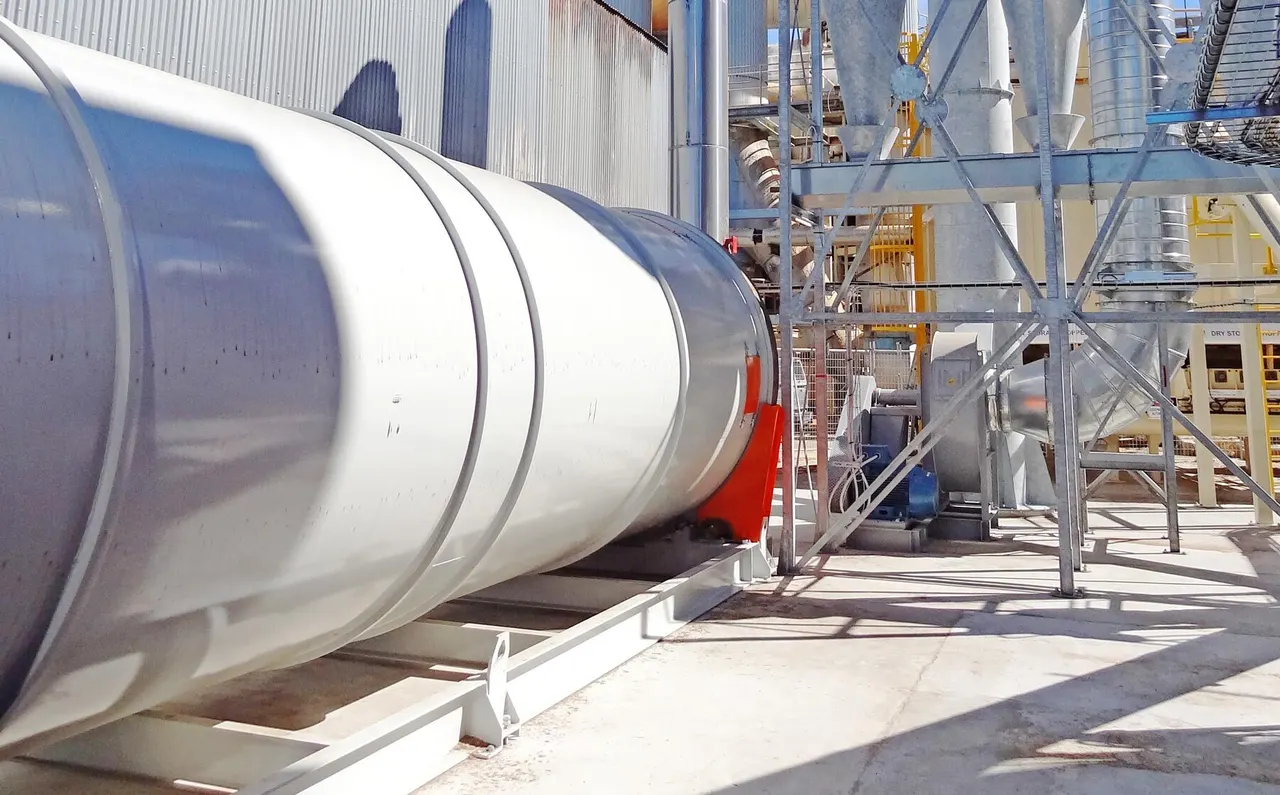
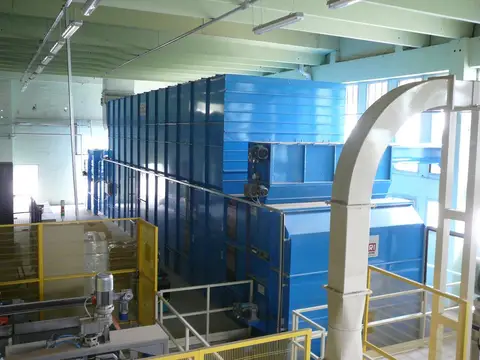
DX are triple-pass drum dryers from the Italian company RP Engineering. They dry wood chips, sawdust, shavings, wood waste and other biomass of medium and fine fraction, including very wet material, ahead of pelleting, briquetting or burning. There are nine models in the range.
What they dry
- Sawdust and wood chips before pelleting, down to 10–12%; the dryer stands in the line between size reduction and the press.
- Wood waste: shredded pallets and packaging, sawmill waste, as raw material for boards, fuel or pellets.
- Biomass and processing residues, for example apple pomace.
- Refuse-derived fuel (RDF/SRF), sludge, and mineral materials such as gypsum.
How the triple-pass drum works
Inside the drum there are three concentric channels. Wet material enters the central tube together with the hot gases, turns at the end and comes back along the middle channel, then turns again and leaves through the outer one. The hottest gas meets the wettest material, so moisture evaporates fastest at the inlet.
Flights on the walls shower the material through the gas stream. Fine particles that have already dried are carried out sooner, while coarse wet ones stay longer, so the moisture at the outlet evens out. The three passes fit into one shell, making the drum shorter than a single-pass one. A fan draws the dry product into a cyclone.
Model range
| Model | Wet material, kg/h | Water evaporated, kg/h | Dry product, kg/h | Thermal power, kW | Electrical power, kW |
|---|
| DX5 | 880 | 380 | 500 | 400 | 15 |
| DX10 | 1,760 | 760 | 1,000 | 850 | 26 |
| DX15 | 2,640 | 1,140 | 1,500 | 1,300 | 35 |
| DX20 | 3,520 | 1,520 | 2,000 | 1,700 | 45 |
| DX25 | 4,400 | 1,900 | 2,500 | 2,100 | 52 |
| DX30 | 5,280 | 2,280 | 3,000 | 2,600 | 55 |
| DX35 | 6,160 | 2,660 | 3,500 | 3,000 | 65 |
| DX40 | 7,040 | 3,040 | 4,000 | 3,500 | 75 |
| DX50 | 8,800 | 3,800 | 5,000 | 4,200 | 90 |
The figures are for drying from 50% to 12% moisture. The key figure for a drum is how much water it evaporates per hour; the drier the incoming material, the more of it passes through. Capacities above the DX50 are engineered to order.
Fuel and furnaces
- A burner on natural gas or diesel.
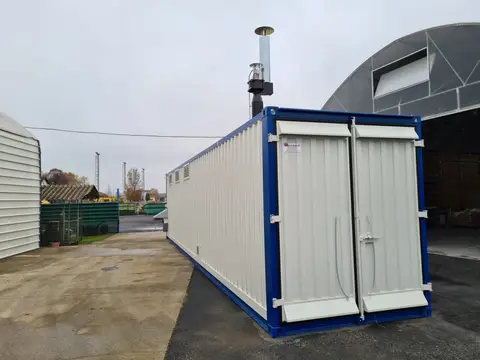
- A biomass furnace with a fixed grate, for fuel with up to 35% moisture.
- A furnace with a moving step grate, for up to 50%: it can burn bark, screenings and wet chips, that is, waste from the same production.
Drum or conveyor dryer
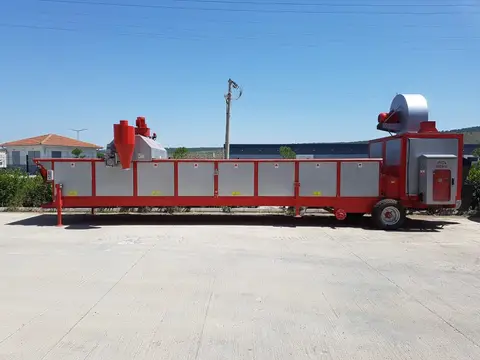
Where heat comes from burning fuel (gas, wood chips, bark, pellets), a drum uses it efficiently and stays compact. Where the site already has low-temperature heat (hot water, steam, heat from a cogeneration unit), a conveyor dryer pays better: it works on heat from 35 °C.
Reliability and safety
- Designed for continuous operation of more than 7,500 hours a year; the tyres are forged.
- Automation: moisture sensors, a process control program, remote access.
- Fire safety: a temperature sensor and a sprinkler at the drum inlet.
- A box with a hatch at the inlet separates stones and foreign objects.
- Made in Italy to EU standards, ISO 9001 certified; UL/CSA or AUS/NZ standards on request.
What a drying line consists of
- intake and storage of wet material: a moving-floor bunker of 10–1,000 m³ or a screw-bottom bunker of 2–40 m³;
- conveyors, magnetic and disc separators, stone traps;
- a hammer mill for wet size reduction, where needed;
- a furnace or burner and the DX drum;
- cyclones and, where needed, bag filters;
- discharge and storage of the dry product.
The drum is supplied on its own frame and set in place by a mobile crane. Describe the material, the capacity you need and the heat source, and we will calculate the model and layout.