Miscanthus growing technology
An alternative to traditional energy sources.
- Price and configuration
- Calculated for your area and conditions
- Delivery
- Within Ukraine and abroad, with customs clearance
- Start-up and service
- On-site commissioning and staff training
Description and specifications
Miscanthus, a fast-growing grass, is a revolutionary energy crop for agriculture. About 40 species are known, found in the tropical, subtropical and warm temperate zones of Asia, Africa and Australia. They are perennials up to 350 cm tall that usually form large, fairly loose clumps with creeping rhizomes; the bases of the shoots are covered with leathery, scale-like leaves. Miscanthus is a hardy plant that grows for 20–30 years or more; if necessary it is removed with a herbicide. It costs almost nothing to grow and needs no care after planting. The low running costs open up wide possibilities for the crop. It is harvested with ordinary forage harvesters, and the harvested material can go directly to heat generation or be made into fuel briquettes or pellets. One tonne of dry miscanthus is equivalent to 400 kg of crude oil. The cost savings at yields of at least 18 t/ha justify growing miscanthus only on a large scale. Returns can be raised through subsidies and tax relief, and by using part of the plantation to propagate the crop and sell planting material. The figures were calculated for an average yield of 15 t/ha and a price of EUR 49 per tonne.
Miscanthus is a very economical and environmentally friendly crop: once planted and established it needs no further care, not even soil cultivation. There are no annual costs for planting material or tillage. All that remains is to take the harvest each year.
Miscanthus is a C4 plant, which makes it very vigorous and hardy. After a single planting, its creeping rhizome sends up new shoots every year. According to current estimates, the crop stays productive for 20–25 years.
After the leaves and shoots die back in winter, the plant dries down to a moisture content of 15–20%. Depending on the site and climate, annual harvests can be expected from two years after planting; the ideal time to harvest is spring. The crop is cut with an ordinary maize forage harvester, or with a mower and a baler.
Miscanthus does not set seed when grown in Central Europe, so it has to be propagated vegetatively. This is done with rhizomes, planted by a planting machine (10,000 plants per hectare). Planting is recommended in April.
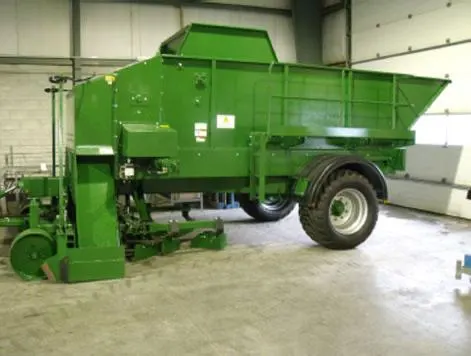
For planting we offer an English-made planter. It can plant up to 20 hectares of rhizomes a day.
Long-term field trials show that one hectare yields on average about 15–20 tonnes of absolutely dry matter, which in heating value corresponds to roughly 8,000 litres of extra-light heating oil.
2.23 kg of finely chopped miscanthus at 14% moisture has the same heating value as one litre of extra-light heating oil.
The crop needs no fertiliser. Miscanthus grows well on any soil suitable for maize. For good establishment, weeds must be controlled in the first two years after planting. Because miscanthus, like maize, belongs to the grass family, weed control products used for maize are also suitable for miscanthus. From two years after planting, the leaves that fall in winter cover the soil completely and suppress weeds, so no weed control is needed in the following years.
Uses:
As a fuel (ideal for automatic heating systems)
In garden design in place of bark mulch
As a substitute for straw under strawberries
Dust-free fine chop is suitable as bedding for horses and small pets
Chopped and fermented miscanthus can serve as a peat substitute in garden soil
Miscanthus is very well suited to making various building materials: wall infill, prefabricated houses, seamless floors, interior and exterior plaster, roof tiles, insulation boards and so on.
For those who plan to grow rhizomes for sale as planting material, we can recommend a trailed harvester for lifting them.
Miscanthus can also be made into biodegradable plant pots, which helps to reduce the use of oil-based plastics that do not break down in nature for centuries. Pots and other products made from miscanthus are fully broken down by micro-organisms.