Berries 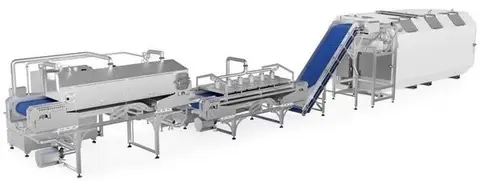
Berry freezing line
Price on request →
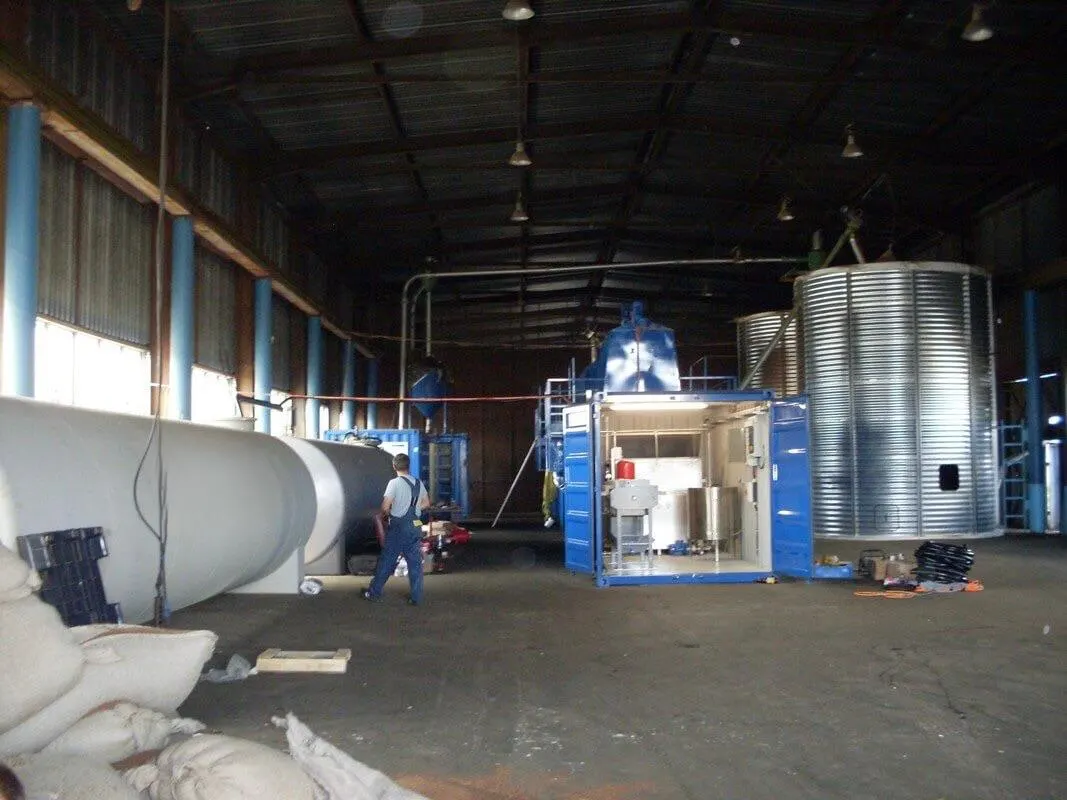
Line for producing rapeseed oil.
A container-type unit for producing cold-pressed rapeseed oil. Made in Germany.
We offer a fully automated unit (in a twenty-foot container) that processes food-grade double-zero rapeseed (low in erucic acid in the oil and in glucosinolates in the meal) into vegetable oil that can be used as diesel fuel. When the oil production technology is followed — and our equipment makes that possible — diesel engines run longer and better than on diesel fuel, fuel consumption falls by 7–10% and engine power rises by 1–2%.
For each machine we can supply a special pump, heat exchanger and three-way valve from Germany.
The engine itself is not modified. It is started on diesel, then switched to oil and runs on oil all day. Before the engine is stopped it runs on diesel for another 3–5 minutes so that no oil is left in the fuel system.
According to Oil World, 60–70 thousand tonnes of rapeseed oil a month are used in Germany alone as a direct substitute for motor fuel (not counting the large volumes used by the biodiesel industry).
The line needs cleaned rapeseed. For cleaning we offer a module for small seeds such as rapeseed.
For refuelling machinery with rapeseed oil we offer a filling station with a dispenser, housed in a container.
The unit is installed very quickly: the container is placed on a prepared site, connected to the power supply and is ready to work.
We can also offer patented combined heat and power units with engines that run on vegetable oils (including rapeseed oil, but not biodiesel) for combined generation of heat and electricity, with the option of converting heat into cooling.
With each unit we supply a small amount of kieselguhr (diatomaceous earth, a filter aid also used in brewing), enough for about 3 days of work. Consumption is 2% per litre of oil produced: if the smallest unit produces 600 l of oil a day, about 12 kg of kieselguhr a day is needed. It binds suspended particles and is removed when the filter is cleaned. For the largest unit, the CAF 2000, we supply 400 kg of kieselguhr to start with.
| For reference | 1 kg of rapeseed oil is about 1.1 l by volume. |
| Oil quality | measured on the CAF unit and required by European standards |
| Density at 15 °C | 919.3 kg/m³ (required 900–930 kg/m³) |
| Flash point | 256 °C (min. 220 °C) |
| Kinematic viscosity at 40 °C | 36.36 mm²/s (max. 38 mm²/s) |
| Calorific value | 37,688 kJ/kg (min. 35,000 kJ/kg) |
| Carbon residue | 0.30% (max. 0.40%) |
| Iodine number | 110 g/100 g (100–120 g/100 g) |
| Sulphur content | 2.3 mg/kg (max. 20 mg/kg) |
| Total contamination | 7 mg/kg (max. 25 mg/kg) |
| Acid number | 0.844 mg/g (max. 2 mg/g) |
| Oxidation stability at 110 °C | 7.6 hours (min. 5 hours) |
| Phosphorus content | 6.4 mg/kg (max. 15 mg/kg) |
| Coke residue | 0.2% (max. 0.4%) |
| Ash content | less than 0.01% (max. 0.01%) |
| Water content | 585 mg/kg (max. 1,000 mg/kg) |

Describe your task — we will select the machinery and calculate the price and delivery time.
+38 (066) 354-00-04 Mon–Fri 9:00–18:00