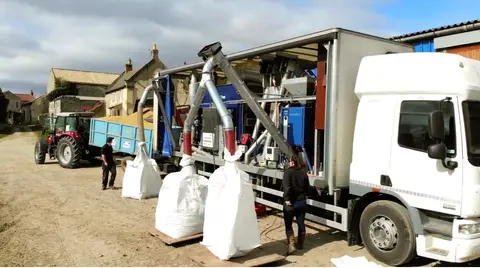
Mobile seed treatment unit
Price on request →
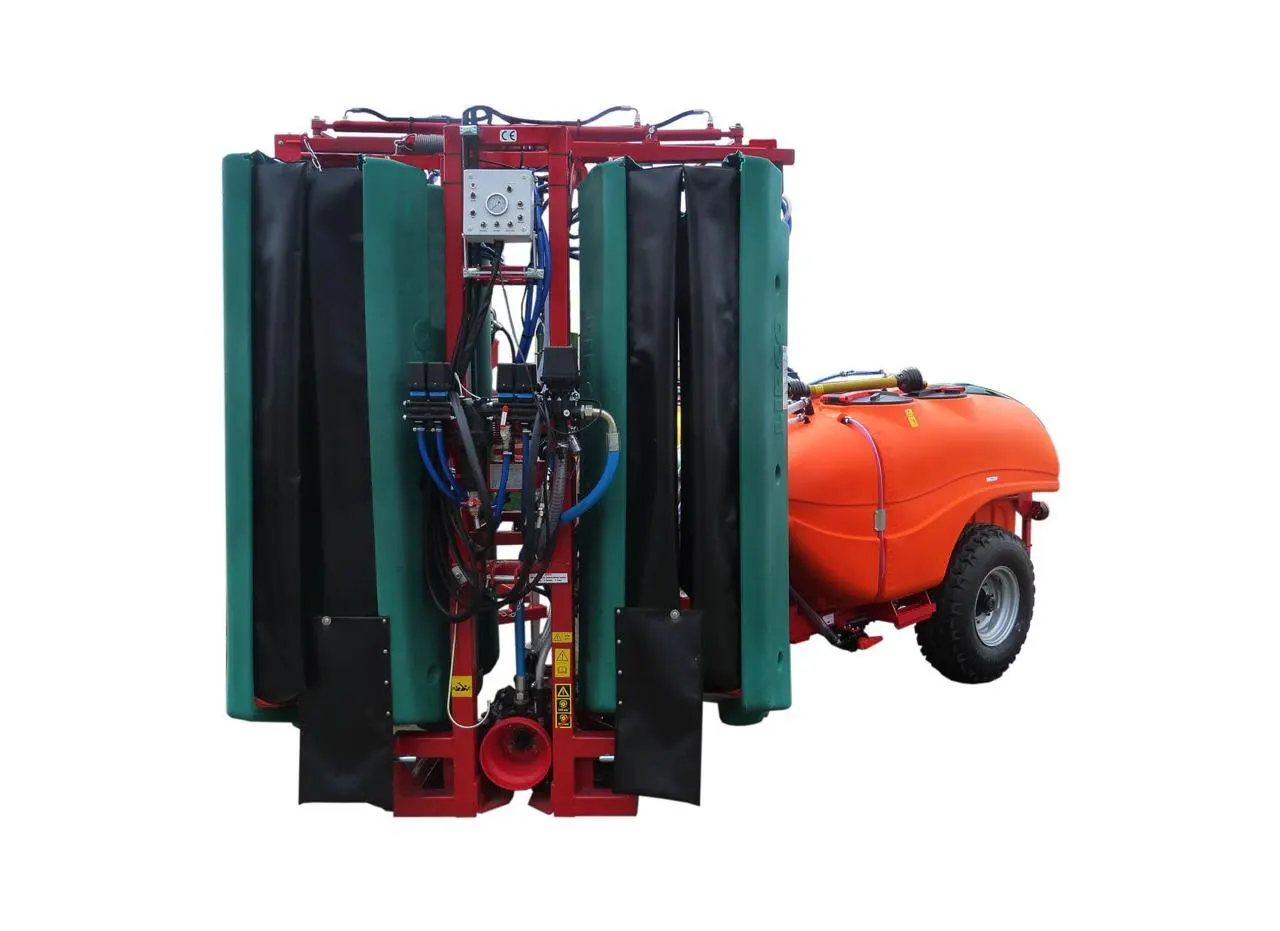
For spraying bushes and vineyards.
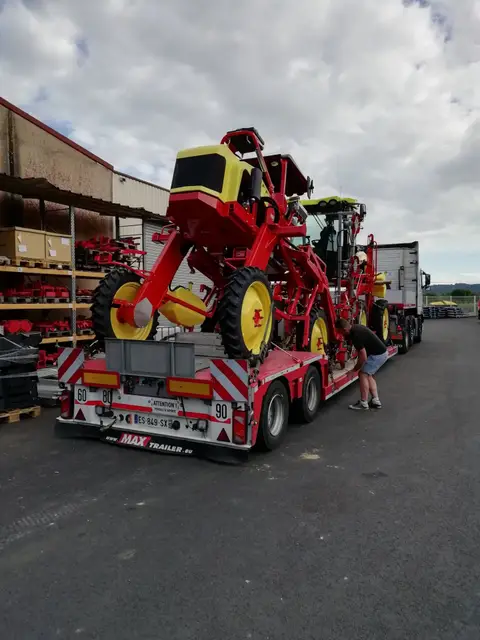
Tunnel sprayer, made in the Netherlands.
| Tank with level indicator | 600 l |
| Pump model | WM70; output 70 l/min, pressure 0–60 bar |
| Rinse water tank | 100 l |
Hydraulically adjustable drawbar and variable tunnel width
Lighting
| External dimensions (width x height x length) | 270 x 360 x 365 cm |
| Internal dimensions | width from 145 to 265 cm, height 335 cm |
6 hydraulically driven fans
Where windy weather is frequent, a tunnel sprayer gives the most effective application of crop protection products to the foliage. The harmful effect of wind on the amount and penetration of spray liquid is a well-known obstacle to treating orchards properly. The only way to reduce it is to choose a time when there is no wind. Sometimes strong wind has made spraying impossible even at night. Windless periods often mean a long wait, and late spraying can cause losses far greater than the price of a new sprayer. Enclosing the tree temporarily in a tunnel makes spraying largely independent of the wind. It also allows part of the spray liquid that settles on the tray to be recovered and reused, which lowers the cost of treatment and reduces environmental pollution. One approach to environmentally safe crop protection is to spray plants with reduced doses of pesticides while minimising their release into the environment. Environmental contamination with pesticides is reduced by 50–85% compared with traditional treatment methods. Using less liquid when spraying trees means not only less risk to the environment but also more even application and higher biological efficacy, even at doses lower than those recommended. The tunnel has 6 radial fans arranged over its height and driven by hydraulic motors; they produce an air stream directed into air diffusers, which carry swirl nozzles. The sprayer has a continuous liquid circulation system with ejectors that draw off the liquid running down the tunnel walls, and a high-capacity self-cleaning filter. Up to 40% of the liquid is recovered, which, combined with the possibility of lowering the pesticide dose by up to 50%, saves up to 70% of the spray liquid compared with traditional fan sprayers.
Because there is no wind drift and losses are minimal, low-volume nozzles are used (total output about 10 l/ha) with high spray quality (droplet diameter 100–200 µm). Our tunnel sprayers work on a closed-cycle principle: the spray is delivered with air streams onto the plants from 2 sides, the excess is caught in the upper part of the screen and fed back in from the sides. As a result, pest infestation of leaves and fruit falls from about 50% to 1–2%. The tight turning circle of the tractor and sprayer makes treatment possible even in very densely planted orchards. The only limits are the height of the trees, which must fit inside the tunnel, and the width of the row along which the tractor travels.
Describe your task — we will select the machinery and calculate the price and delivery time.
+38 (066) 354-00-04 Mon–Fri 9:00–18:00