Forage crops 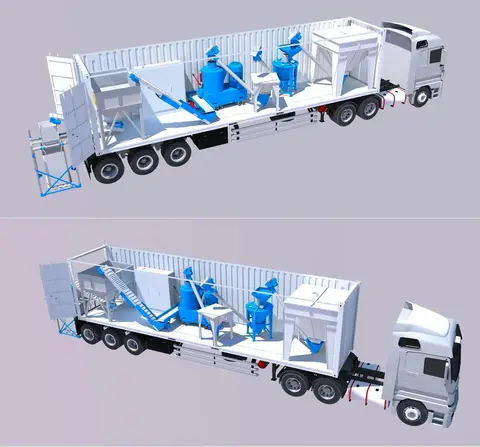
Mobile pellet plant
Price on request →
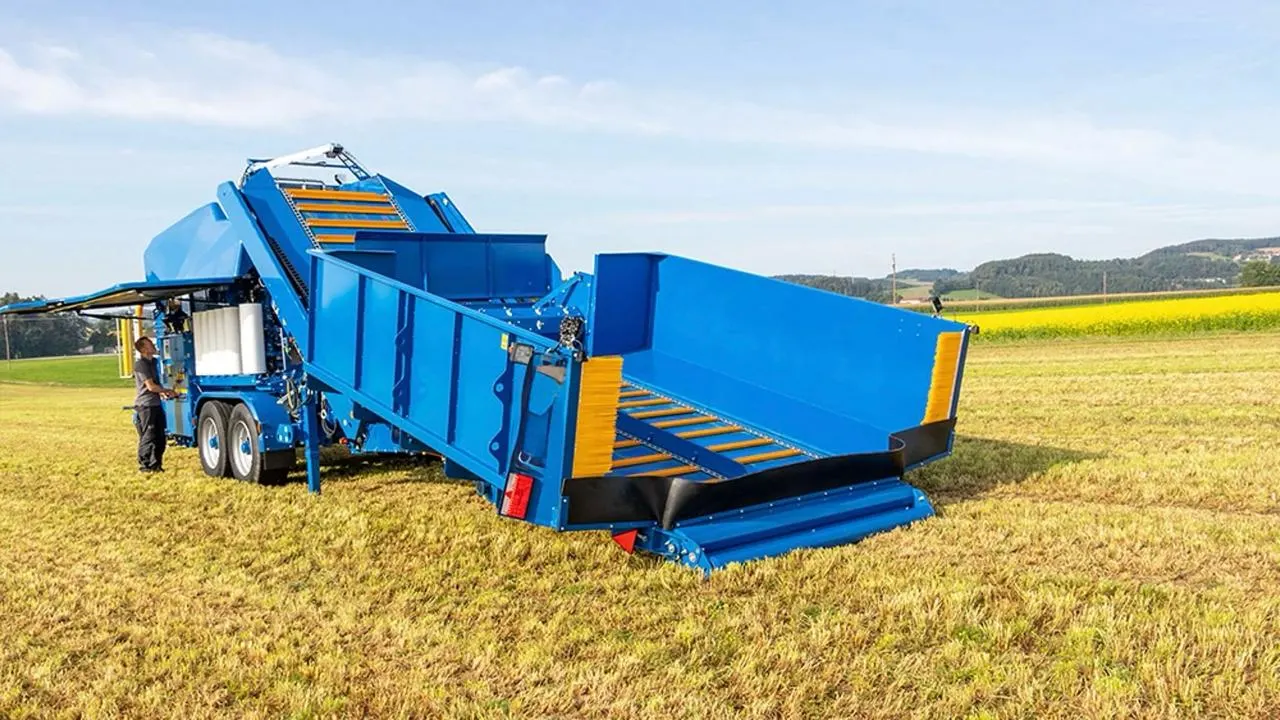
Mobile unit for conserving forage by pressing it into bales.
A mobile unit that receives chopped material and presses it into round bales, made in Austria
With a permitted transport speed of up to 80 km/h (behind a lorry), the machine gets to the job quickly.
It is quick to set up: positioning takes a couple of manual steps, and to start work you only need to set the bale density, the number of film layers and the filling speed of the bale chamber on the control panel. Depending on the space available, the machine can swing to the left or right of the tractor into its working position. A distinctive feature is the two large film magazines with a total capacity of 20 rolls. They are located on the sides of the machine and are moved hydraulically.
The press is supplied with forage by a special receiving conveyor mounted on the machine. Material can be tipped onto the receiving conveyor (working width 3.50 m), from where a ribbed conveyor passes it to the press. The bale chamber is always filled evenly thanks to an advanced measuring and feed system.
| Total weight | 15,200 kg |
| Bale size | diameter 0.6–1.15 m, width 1.2 m |
Up to 50 bales per hour. Assuming a bale weighs about 320 kg, output can be about 16 t/h.
The machine can also be used for materials such as sugar beet pulp, straw meal and premixes.
The fixed bale chamber is designed for forming round bales. Because a roller press would be unsuitable for chopped material (scatter leads to heavy losses), endless belts on rollers work in both halves of the chamber. The tension of both belts can also be adjusted hydraulically. This gives a stable start to pressing and helps the bale to be ejected cleanly. The pressed bale is bound with net.
Under the press is a return belt that catches scattered material and returns it to the bale chamber. The press is driven by the tractor through the PTO (about 110 hp required). The conveyor belts and the wrapper are operated hydraulically.
The moving wrapping table travels on longitudinal rails under the tailgate, where it takes the pressed and bound bale from the press. As soon as the wrapping table is in the right position, wrapping begins.
At the same time a new pressing cycle starts. The wrapper has two film stretch units (for 750 mm film) with film monitoring, and an automatic device for cutting the film and discharging the finished bale. Discharge is controlled by an ultrasonic sensor: if a bale is already lying at the discharge point, the process stops.
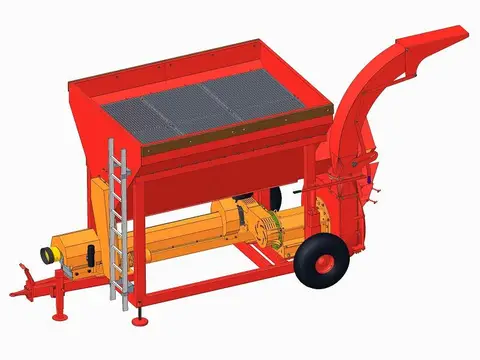
The unit can also be driven by a power unit that turns the shaft in place of a tractor. Required power: 90 kW. Electrical supply: 400 V, 50 Hz, maximum 125 A. It can work at temperatures from −15 °C to +60 °C.
Weight 2,970 kg. Dimensions: 1,773 x 1,323 x 1,652 mm.
Describe your task — we will select the machinery and calculate the price and delivery time.
+38 (066) 354-00-04 Mon–Fri 9:00–18:00